Home/Services/VR Training Simulation
Immersive Learning

VR Training Simulation

Immersive VR simulations that build real competence under real pressure, for high-risk industries where the gap between knowing a procedure and performing it can be the difference between a safe day and a serious incident.

The Problem

Everyone Passes the Training. People Still Get Hurt.

Safety training completion rates are near 100% across most industries. Everyone watches the video, answers the quiz, signs the form. And yet workplace injuries persist, because passing a knowledge test and performing under pressure are fundamentally different skills.

The estimated global cost of workplace injuries exceeds $250 billion annually. The vast majority of those injuries happen to people who had “completed” their training.

The problem isn’t knowledge. It’s practice. You can read about an emergency evacuation procedure. You can recite it. But when the alarm goes off, the air smells wrong, and people around you are running, knowing the procedure and being able to execute it are two entirely different things.

275%More confident applying skills after VR training, PwC 2020
4xFaster to train than in the classroom, PwC 2020
3.75xMore emotionally connected to the content, PwC 2020
The Science

Why Simulation Works

Pilots train in flight simulators. Surgeons practise on virtual patients. The military rehearses operations in simulated environments. This isn’t new.

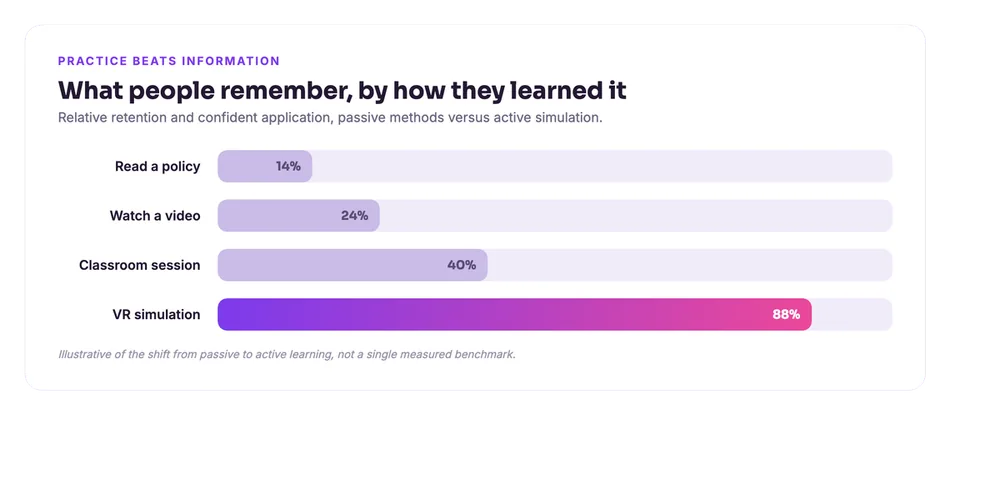
When the brain processes a simulation as a real experience, it builds the same neural pathways that real experiences build. So when the real situation occurs, the person draws on practice, not just memory. PwC’s 2020 study found VR-trained employees were faster to train, more confident, and retained and applied skills significantly better under pressure than classroom or eLearning peers.

Traditional training fills the knowledge gap. Simulation training fills the performance gap, the gap that only appears under pressure, which is exactly when it matters most.

Retention by training method, passive learning versus VR simulation
What We Build

VR Training Solutions

Four simulation types, each built around a moment where practice beats information.

Safety & Emergency

Rehearse the crisis, safely

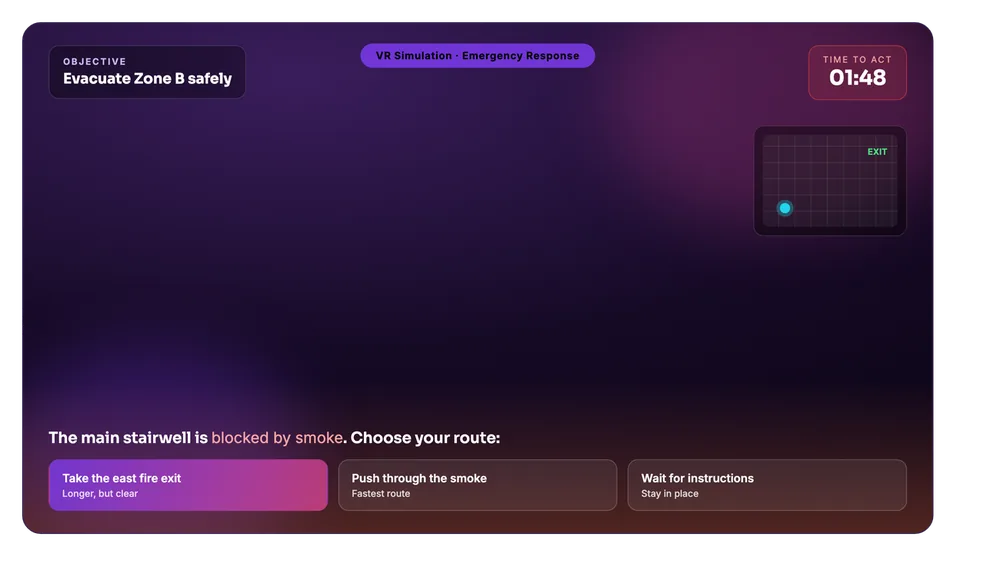
Realistic simulations of emergency scenarios where trainees make decisions under time pressure with realistic environmental cues, noise, visual stress, consequence feedback, in a zero-risk environment.

  • Fire and evacuation drills with dynamic, unpredictable elements
  • Chemical and hazardous material response procedures
  • Confined space entry and rescue scenarios
  • Height, fall protection, and medical emergency response
VR emergency-response simulation with a fire evacuation decision
Equipment & Process

Practise on a virtual twin

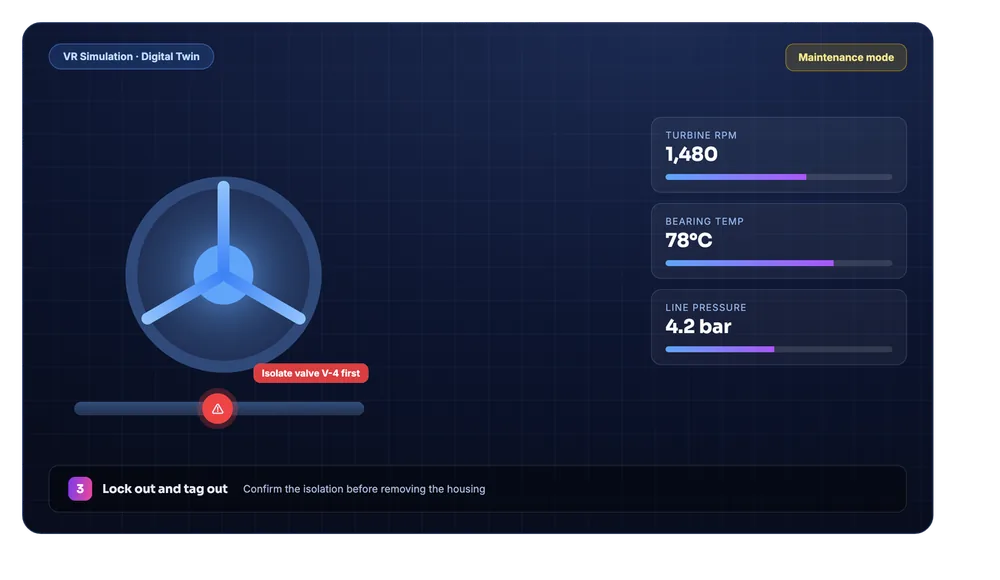
Virtual replicas of your actual equipment, machinery, and working environment. Operators learn to handle your specific systems before touching anything real, reducing error rates and time-to-competency.

  • Plant and machinery operation walkthroughs
  • Assembly line and manufacturing process training
  • Control room and SCADA system simulation
  • Vehicle and heavy equipment operation
VR digital twin of plant equipment with live parameter readouts
Onboarding & Site Familiarisation

Ready before day one

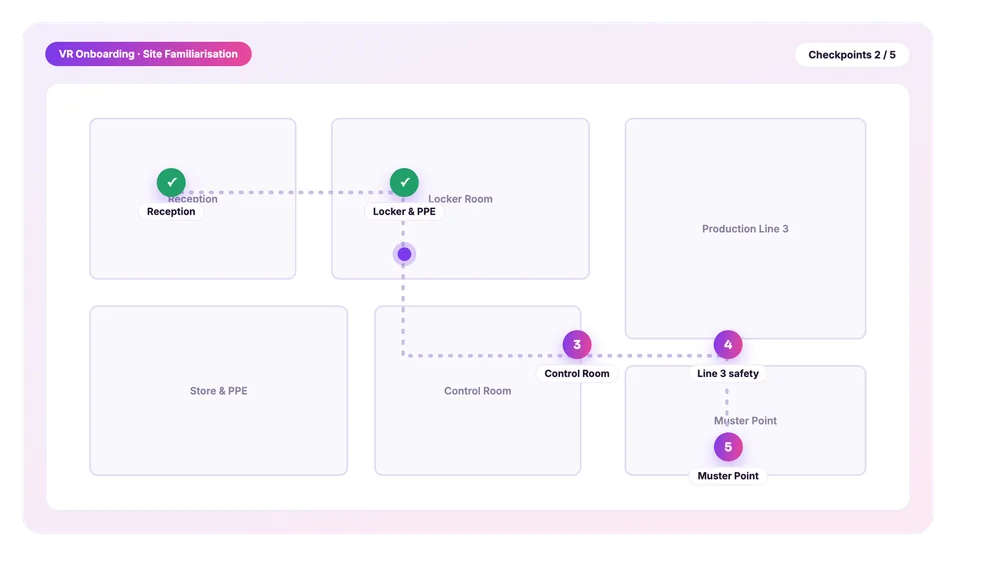
New hires walk through a realistic simulation of their working environment before their first day. They learn layouts, safety protocols, equipment locations, and standard procedures through practice, not presentations.

  • Virtual site tours with interactive checkpoints
  • Role-specific task walkthroughs
  • Safety protocol practice in context
  • Measurable readiness assessment before site access
VR site-familiarisation walkthrough with checkpoints
Soft Skills & Leadership

High-stakes conversations, rehearsed

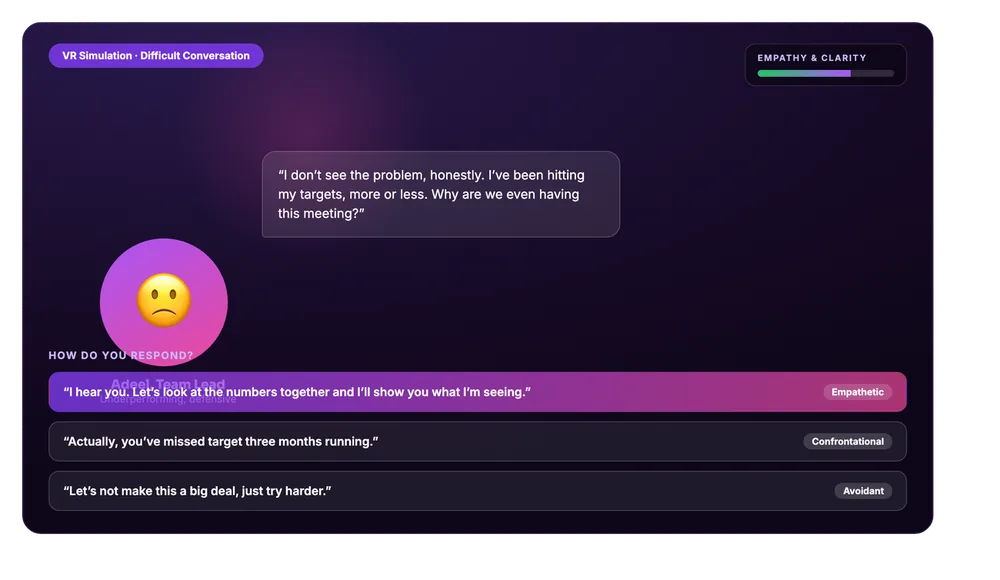
Not all high-stakes moments involve physical danger. Difficult conversations, crisis communication, customer escalation, and ethical decision-making can all be practised in immersive scenarios with AI-driven responses.

  • Difficult conversation simulations for managers
  • Customer complaint and escalation handling
  • Crisis communication under pressure
  • Ethical decision-making scenarios
VR difficult-conversation simulation with tone-scored responses
Industries We Serve

Where the cost of a mistake is highest

Where the cost of a real mistake is highest, the case for simulation is strongest.

Oil & Gas

Emergency response, H2S exposure, permit-to-work procedures, rig operations, and confined space entry, trained where the consequences of failure are greatest.

Construction

Height safety, crane operations, scaffolding inspection, and site induction. Train workers on site-specific hazards before they set foot on the actual site.

Manufacturing

Machine operation, assembly processes, and quality control procedures. Reduce ramp-up time and error rates for new operators.

Healthcare

Patient handling, emergency triage, surgical preparation, and infection control. Practise clinical procedures without patient risk.

Logistics & Warehousing

Forklift operation, warehouse navigation, loading procedures, and cold chain management. Reduce incident rates and time-to-competency for new hires.

Energy & Utilities

Substation operation, high-voltage safety, and turbine maintenance. Train on equipment that’s too expensive or dangerous to learn on live.

The ROI Case

When VR Training Is Worth It

VR training is not for everything. For standardised compliance content, eLearning is more cost-effective. VR earns its premium when one or more of these conditions apply:

  • High consequences of failure, a real mistake costs far more than the simulation
  • Performance under pressure matters, the skill is executing, not just knowing
  • Physical environment is critical, spatial awareness can’t be taught from a screen
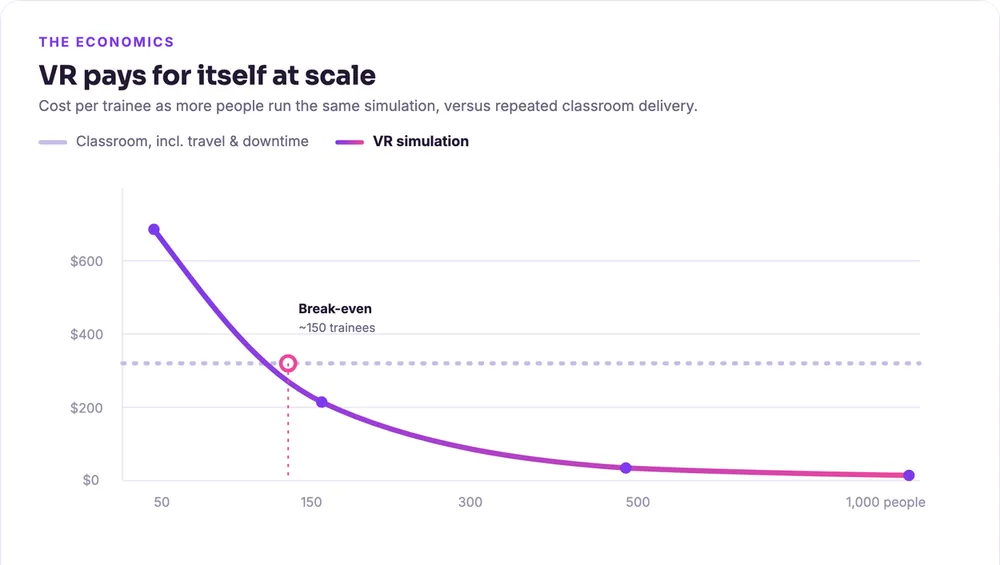
  • Scale justifies the investment, many people need the same training
  • Traditional training is expensive or impractical, downtime, travel, or safety constraints

We provide a free business case template that helps you calculate whether VR makes financial sense for your specific use case. Sometimes the answer is no, and we’ll tell you that.

VR break-even chart: cost per trainee falls below classroom cost at scale
How We Work

Our Process

Five steps from feasibility to a deployed, measurable simulation.

1

Feasibility Assessment

We evaluate whether VR is the right solution for your challenge. Not every problem needs simulation, and we’ll tell you if eLearning or blended learning is a better fit.

2

Scenario Design

We work with your subject-matter experts to design realistic scenarios based on your actual environment, equipment, and procedures.

3

Development & Testing

Our team builds the simulation, tests it with representative users, and iterates on feedback. Every interaction is validated against the learning objective.

4

Hardware & Deployment

We advise on hardware, standalone headsets like Meta Quest or PC-tethered for higher fidelity, handle deployment, and train your facilitators.

5

Analytics & Reporting

Every session generates performance data: time to complete, decisions made, errors, hesitation points. It feeds your LMS and informs targeted follow-up training.

FAQ

Common Questions

How much does VR training cost?

A custom VR training simulation typically ranges from $15,000 to $80,000 depending on environment complexity, number of scenarios, and interactivity level. Hardware costs are separate (standalone headsets like Meta Quest run $300 to $500 per unit). The per-person cost drops significantly at scale: a $50,000 simulation used by 500 people is $100 per person, often less than the cost of one day’s classroom training including travel and downtime.

What hardware do we need?

For most corporate training, standalone headsets (Meta Quest 3 or similar) are the practical choice: no PC required, easy to deploy, and sufficient quality for training scenarios. For applications requiring higher visual fidelity (architectural walkthroughs, detailed equipment simulation), PC-tethered headsets offer more power. We advise based on your specific needs.

Can VR training be tracked in our LMS?

Yes. Our VR simulations support xAPI (Tin Can) standard, so all performance data, completion, scores, time, decisions, and error patterns, flows into your existing LMS alongside your other training data.

How long does development take?

A single scenario typically takes 8 to 14 weeks from design to deployment. A multi-scenario programme with a shared environment can take 16 to 24 weeks. We run content development and hardware procurement in parallel to compress timelines.

Do people get motion sickness?

Modern standalone headsets and well-designed experiences have largely solved this. We follow established comfort guidelines: no artificial locomotion (the user stays in place or teleports), high frame rates, and short sessions (typically 10 to 20 minutes). In our deployments, discomfort rates are consistently below 5%.

Is VR just a gimmick?

For generic compliance training, yes, it would be. That’s why we don’t recommend it for that. VR earns its value in specific conditions: high-risk scenarios, performance under pressure, spatial and procedural training where practice beats information. When those conditions apply, the evidence is strong. When they don’t, eLearning is a better investment, and we’ll say so.

Is VR Right for Your Training Challenge?

Download our free VR Training Business Case Template. It includes the cost, benefit, and break-even framework for deciding whether a VR simulation is worth the investment for your specific scenario.

Download the Free Template

Or book a 30-minute call to discuss your specific training needs.