If your team is still running training on spreadsheets, shared drives, and the occasional classroom session, the question isn’t whether you need a system, it’s how much that patchwork is quietly costing you. So, what is an LMS? A Learning Management System is the central platform where you deliver, track, and measure all your training, online and in person, in one place. This guide explains what an LMS actually does, the features that matter, and how to tell when your organization is ready for one.
We help SMEs and mid-market firms across Pakistan, the UAE, and Saudi Arabia move from ad-hoc training to structured, measurable learning, and the LMS is almost always the foundation.
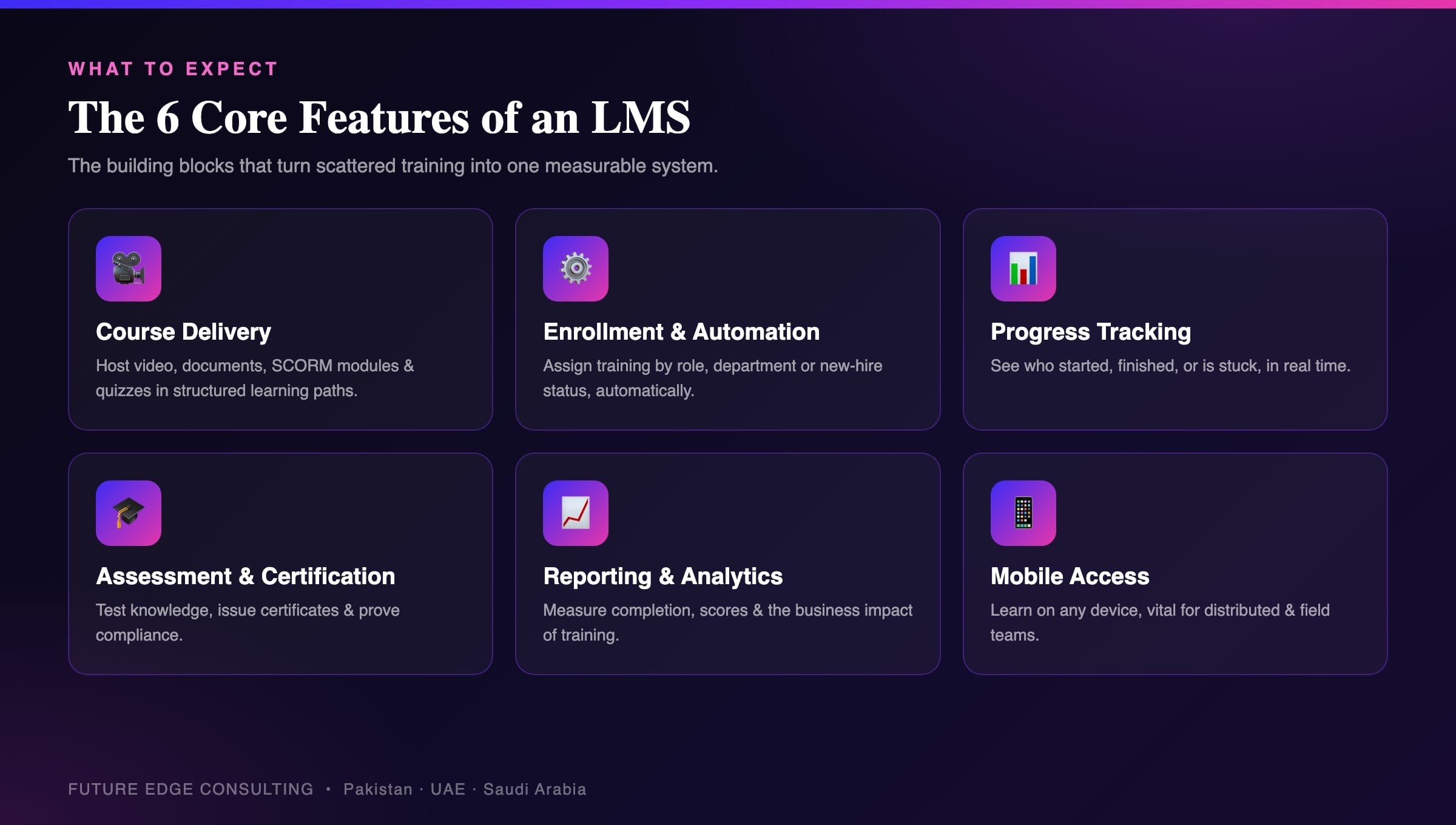
At its simplest, an LMS replaces the scattered way most companies handle training. Instead of chasing attendance sheets and emailing PDFs, you get one system that hosts your courses, enrolls your people, tracks their progress, and reports on completion and results. It works for onboarding, compliance, product training, leadership development, and partner or customer education alike.
Here’s the part most training programs miss. Over a century ago, psychologist Hermann Ebbinghaus mapped the “forgetting curve,” and the finding has held up ever since: without reinforcement, people lose the majority of newly learned information within days. A one-off classroom session, however good, decays fast. The value of an LMS is that it makes reinforcement practical, spaced refreshers, quick reassessments, and refresher nudges that flatten the curve and keep knowledge in place. Cognitive-science research on spaced repetition and retrieval practice points the same way: people retain far more when learning is repeated and tested over time, not delivered once.

Illustrative of the Ebbinghaus forgetting curve. The point is the shape, not exact percentages: reinforced, spaced learning retains dramatically more than a single session.
Ad-hoc training feels cheaper because the cost is hidden. Trainers repeat the same session for every new cohort, knowledge walks out the door when someone leaves, and nobody can prove what was actually learned. An LMS turns training into a reusable asset: you build a course once, and it serves every new hire automatically, with a record of who completed what. The cost moves from people’s time to a system that scales.
Not sure which LMS fits your team? Let’s map it out together
Book a free L&D strategy session →The best LMS is the one that fits how your people actually work, not the one with the longest feature list. Start with your real use cases, onboarding, compliance, or upskilling, then look for a platform that’s easy to administer, simple for learners, and able to report the numbers leadership cares about. Integration with your HR or ERP system is a big plus, because it keeps your people data in sync. This is exactly where Future Edge’s e-learning and LMS solutions come in: we help you select, set up, and populate the right platform.
An LMS is the difference between training that depends on whoever is free that week and training that runs reliably as your organization grows. Pair it with well-designed content and a clear plan, and learning becomes a measurable driver of performance. Our corporate training and e-learning teams build both the platform and the programs that fill it. Book a free strategy session to plan yours.
Future Edge Consulting delivers LMS and e-learning, corporate training, Odoo ERP implementation, and digital transformation across Pakistan, the UAE, and Saudi Arabia.
Talk to our experts and discover smart solutions to grow, automate, and future-proof your business.
Schedule a quick call